
Check Des Moines Voter Registration
The official VoteWA registration and ballot portal is the first stop for a voter checking their own current record. It authenticates the user with an exact registered name and full date of birth. It does not let a visitor browse people by surname. Once the identity match succeeds, the voter can review registration and ballot information, see ballot status, find a voter guide, locate drop boxes or voting centers, and reach the correct county contact.
| Lookup field | Input | Needed | How it works |
|---|---|---|---|
| First Name | Text | Yes | Must match voter registration; autocomplete is off |
| Last Name | Text | Yes | Must match voter registration; autocomplete is off |
| Date of Birth | Text | Yes | Full date in mm/dd/yyyy, up to 10 characters |
| Language | Selector | No | Changes the page locale |
| Sign In | Button | Yes | Runs the identity match |
Enter the names as registered, add the birth date, then select Sign In. A failed match does not reveal whether a person with a similar name is enrolled. Check spelling and any recent name change before contacting King County Elections. That design protects the voter roll from casual browsing while giving each voter a direct way to manage a record.
The captured King County My Voter Information screen shows the county's identity-and-address fields for personalized access.
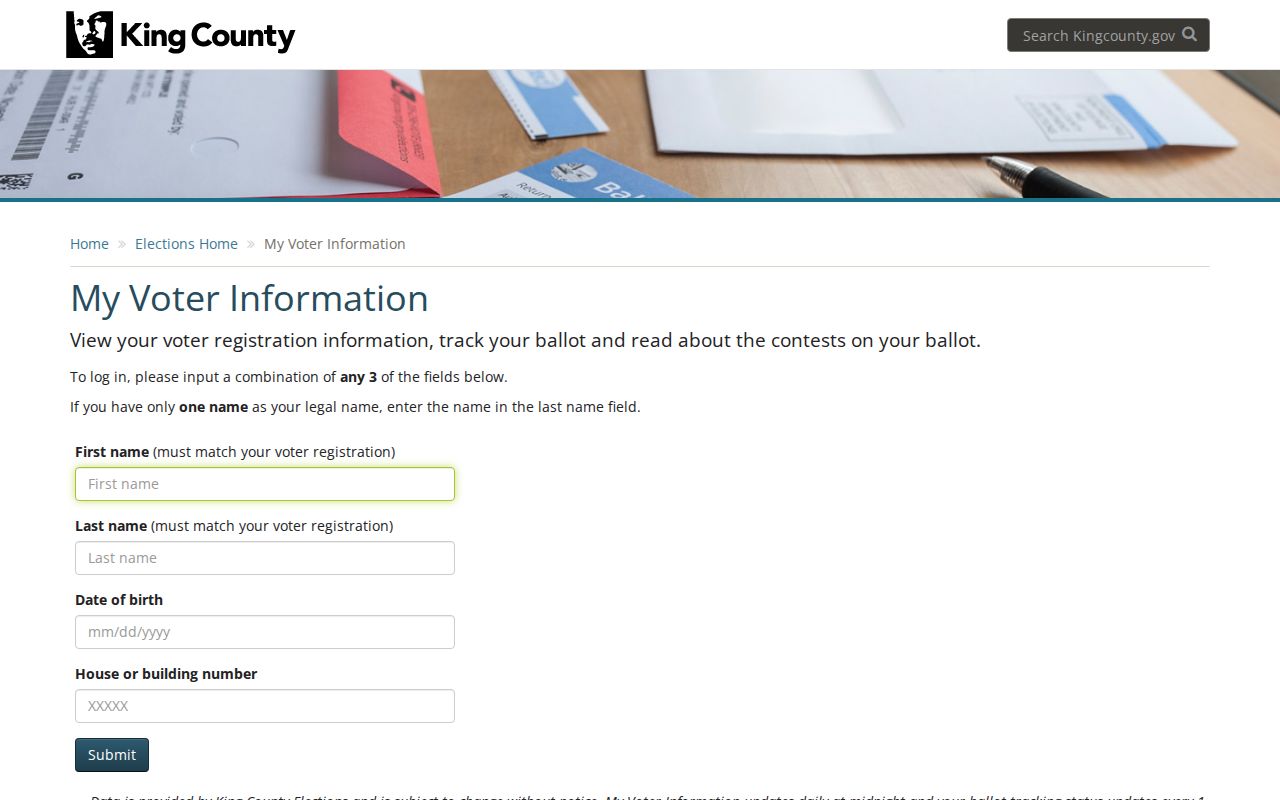
This county screen reinforces the key limit: personalized lookup tools verify the voter, while a public voter-file request follows a separate legal process.
Des Moines Voter Records Are County Records
Des Moines has no separate city voter file. King County Elections administers local records within Washington's statewide database. That division matters when a lookup fails or a researcher needs more than a personal portal can return. Questions about a current Des Moines record go to the county office. A request for the comprehensive statewide voter roll goes to the Secretary of State.
King County Elections is at 919 SW Grady Way, Suite 100, Renton, WA 98057. The main line is 206-296-VOTE (8683), and the office is open Monday through Thursday, 8:30 a.m. to 4:30 p.m. Records inquiries use ElectionsPDR@kingcounty.gov or 206-296-1565, with GovQA available from the contact page. Paper and electronic lists are also handled through Voter Services.
The official contact page is shown in this King County Elections office capture.
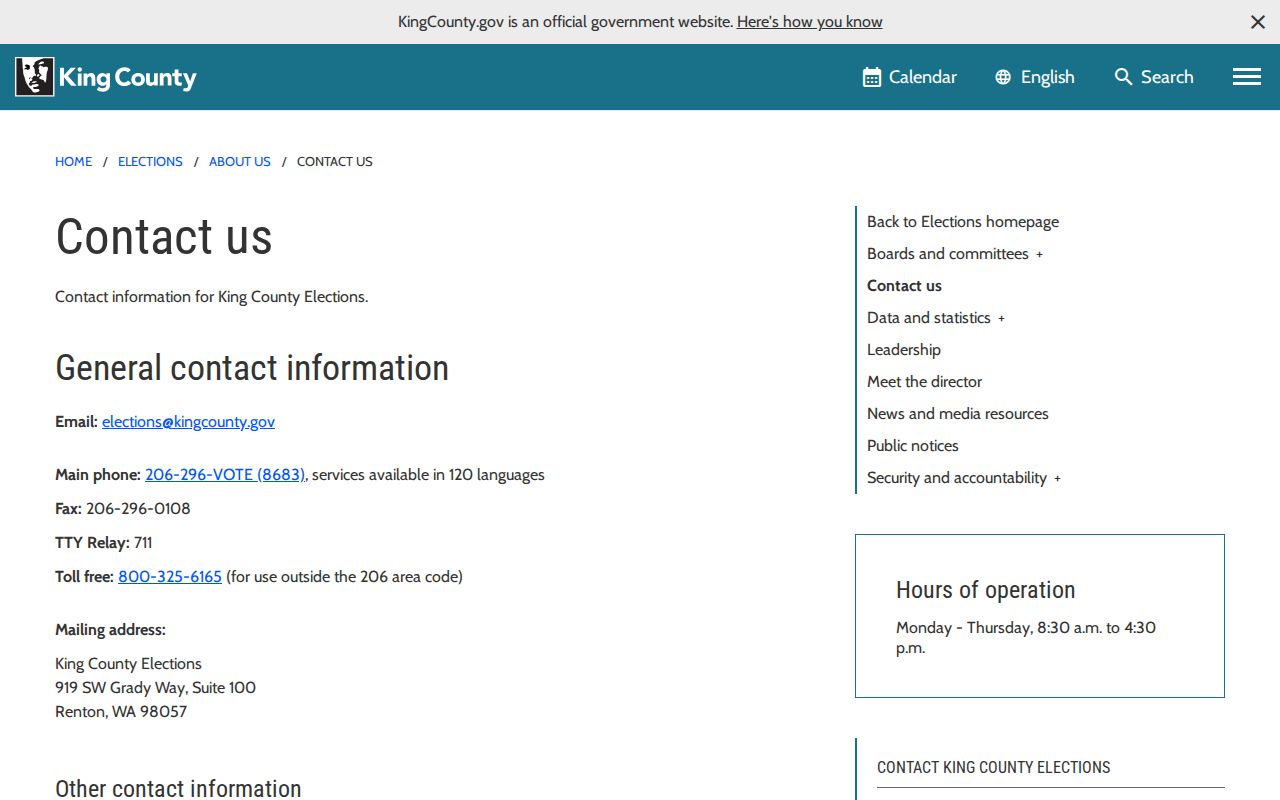
These direct channels provide the fallback when online authentication fails, a correction is pending, or a request needs help from the custodian.
What Washington Voter Records Reveal
Washington law separates the automated voter file from the original registration form. The public file can identify a voter and show election participation, but it never reveals a marked choice. Washington also does not register voters by political party. Read “voting record” as a list of elections in which the person participated, not a record of candidates or measures selected.
| Name | Listed in the automated voter file |
|---|---|
| Residence address | Public unless protected through the Address Confidentiality Program |
| Political geography | Precinct and represented districts or jurisdictions |
| Gender | The database value |
| Birth information | Year is public; the full date is confidential |
| Voting record | Election participation only, never ballot selections |
| Registration details | Registration date and state voter identifier |
| Party affiliation | Not collected because Washington has no party registration |
Confidential by law. Under RCW 29A.08.710, the original form, full birth date, driver or state ID number, Social Security fragment, signature, phone, and email are not public. An actual residence protected by RCW 40.24.060 also stays confidential.
The registration-source agency and a person's choice not to register are confidential under RCW 29A.08.720. Future Voter information for people under 18 is generally protected as well. Those limits apply even when a requester can lawfully receive the broader public extract.
Protected Des Moines Voter Addresses
Washington's Address Confidentiality Program gives qualifying survivors and household members a substitute address for public-facing records. For an enrolled voter, the actual residence is not released with ordinary voter registration data. The Secretary of State administers the program under chapter 40.24 RCW.
A missing or substitute address should not be treated as proof that a record is false. It may reflect a lawful safety measure. Do not try to defeat that protection through other records or indirect searches. Public access never permits stalking, threats, tracking, or harassment.
Note: A protected address is an intentional safeguard, not an incomplete field that a requester is entitled to fill.
Request Washington's Voter Registration File
The Washington voter database extract is the route to a comprehensive list of active registered voters. It includes current-year and prior-year participation history plus precinct and district data. The file is refreshed at the start of each month, normally by the end of the first business day. Delivery is a delimited CSV, and the state warns that its size may call for database software and skill.
- Enter the requester's name, email, phone, street address, city, state, and ZIP on the state extract form.
- Select the data file and choose King County when a county-specific extract fits the need.
- Accept the legal-use statement covering RCW 29A.08.720, RCW 29A.08.740, and the state list-use rule.
- Submit the request and use the approved download link sent by email. Requests may take up to five business days, though many are fulfilled at once.
No fixed fee is shown for the current electronic download. RCW 29A.08.720 permits the actual cost of reproduction, so “no fee shown” is more precise than promising free access. Questions may be sent to elections@sos.wa.gov or 360-902-4194. The full statewide file is not the same as the VoteWA self-lookup.
Limits on Des Moines Voter Rolls
Supplied voter lists cannot be used to mail or deliver commercial advertisements, offers, or solicitations. Political use is allowed. A recipient must take reasonable steps to prevent downstream misuse. RCW 29A.08.740 makes prohibited commercial use a class C felony, punishable by up to five years, a fine of up to $10,000, or both. The law also provides $5 in civil nuisance damages for each item delivered.
Use voter records lawfully. Never use voter information to stalk, harass, threaten, impersonate, track, or harm a person. Preserve evidence and contact King County Elections or law enforcement if voter-list misuse occurs.
Washington harassment and stalking laws can apply to threats, repeated unwanted contact, monitoring, and nonconsensual electronic tracking. Access to a public field is not permission to cause fear or distress. General agency disclosure rules are covered separately in the Des Moines public records process.
How King County Maintains Voter Records
Washington launched its centralized voter registration database in January 2006. Each month, state health and Social Security death lists are compared by name and birth date. Possible matches go to county auditors, and the state says deceased registrations are usually canceled within a month. Auditors may also act on obituaries or written notice from relatives.
Other changes follow set processes. Department of Corrections records can flag a person currently incarcerated for a felony, with notice and generally 30 days to dispute cancellation. Undeliverable election mail may move a record from active to inactive. These labels describe database status and should not be guessed from a single returned mailing.
An especially focused route exists under RCW 29A.08.770. List-maintenance records, including notice recipients, replies, removals, and reasons, remain open to inspection for at least two years, subject to protections for people under 18. Ask for a defined date span and maintenance action instead of making a vague request for the whole roll.
Des Moines Voter Registers Before VoteWA
Current voter registration systems answer present-day status questions. Historical research follows a different trail. King County Elections holds voter information from 1995 forward. The Puget Sound Regional Archives election history reaches back to county registrations from 1884 through 1934, with most surviving registers from 1916 through 1934 arranged by precinct or ward.
Those older entries may show a name, registration date, age, birthplace, occupation, time living in the precinct, and naturalization date or court. Cancelled voter cards from 1935 through 1994 can supply a name, address, precinct, and first-registration date, but they do not show the cancellation date. Some fields may still be withheld under voter confidentiality law.
The structure changed over time. Before 1938, municipal clerks registered city voters while the county auditor covered unincorporated areas. Statewide tracking did not become unified until the mid-1930s. Des Moines incorporated in 1959, so a person tied to the area in an earlier year will appear in King County records, not a city voter ledger.
Search Historic Des Moines Voter Geography
Precinct arrangement makes place knowledge vital. A historical resident may be indexed with Zenith, Redondo, Woodmont, Midway, North Hill, or another community name rather than modern Des Moines. The date matters too. A county registration record can predate the city's legal boundary and still describe someone who lived in the area now associated with Des Moines.
Pair a register entry with a period address, assessment roll, newspaper, naturalization record, or directory. This can bridge years between federal censuses and help distinguish two people with similar names. Search name variants with care, especially when handwriting or later indexing may have changed spelling. Do not infer identity from a name alone.
Archive access is the non-digital channel for these voter records. Give staff a name, likely date range, and possible precinct or historic place. Specific facts make retrieval more reliable than a broad request, and they help an archivist locate the right register, poll book, or cancelled card.
Note: Historical voter registration proves a recorded residence and date, not a person's current address, identity, or voting choices.